
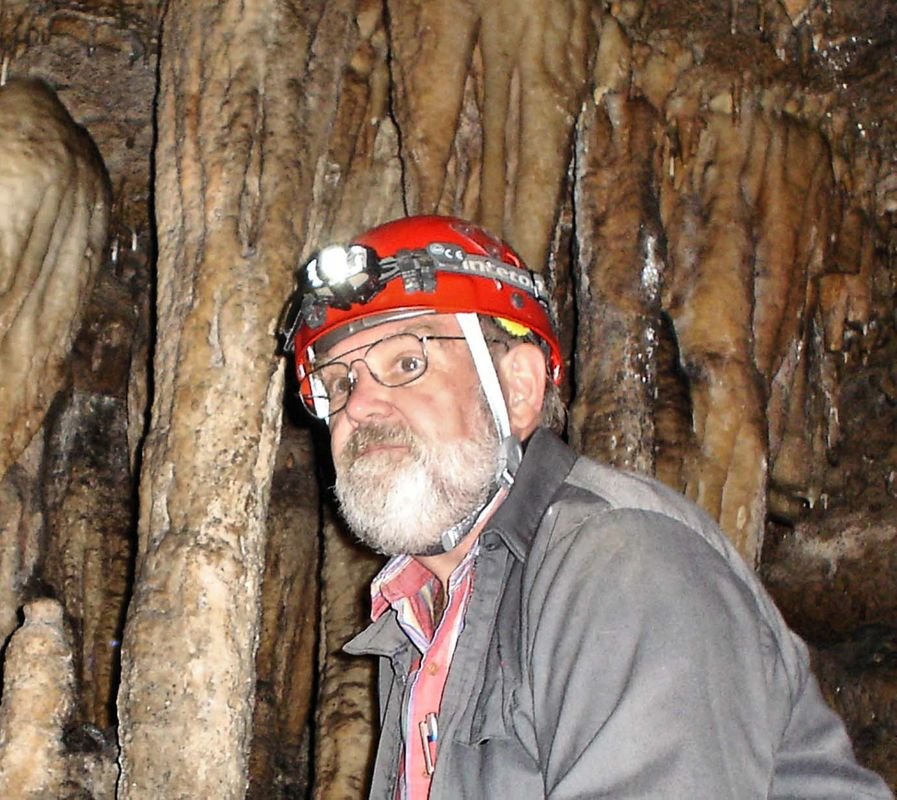
In loving memory of Cave historian
and preservationist, Jim Whidby.
The history of Cherokee Caverns
The caverns began forming approximately 500 million years ago during the upper Cambrian period. Shells and skeletons of ancient marine life mixed with sand, clay, and other material to form the Copper Ridge Dolomite rock.
This occurred in an inland sea, which covered the area at that time. Ancient earthquakes created cracks in the Dolomite rock, as the inland sea gradually receded the water enlarged the cracks to form the caverns. Groundwater, acquiring a small amount of carbonic acid from the air and vegetation on the surface, dissolves the Dolomite rock as it works its way into the caverns.
The Caverns were first entered by early American Indians as indicated by cane torch marks (stoke marks) found on the cavern's walls. The caverns were rediscovered about 1854 by Robert Crudgington, a farmer. According to legend, Crudgington was hunting on the hillside when he noticed fog emerging around rocks. After moving the rocks he entered the caverns and at the time was thought to have been the first person to see the caverns. In 1866 Crudgington bought 800 acres of farmland, including the caverns. Crudgington’s daughter, Margaret Crudgington Gentry was urged by friends to open the caverns to the public.
In 1929 the first commercial tours were given under the name Gentry’s Cave, but within a year she renamed it Grand Caverns. The caverns were well advertised and were well visited by many people. In 1946 Margaret passed away and her family sold the caverns in 1947. The property and cave were leased resulting in it being renamed, Atomic Caverns. This name came from a large stalagmite column, which was thought to resemble the bottom of the “mushroom” of the famous Bikini Atomic test, which was heavily publicized during that time. During this period of time Homer Harris, known as the world's tallest singing cowboy, along with his famous performing trick horse, “Stardust’ held a one-day western music show in the Crystal Ballroom of the caverns. A second show was held outside the cavern's entrance. Admission price for adults was 75 cents and children 35 cents, for both shows.
In the mid-1950s the caverns were redeveloped once again and opened with the name Caveman’s Palace, but after a short time, the name was changed to Palace Caverns.
In the 1960s much improvement was made to the cavern trail and lighting. A restaurant was built over the cavern entrance and the cave was reopened with a new fifth name, Caverns Of The Ridge.
In 1970 the caverns underwent further development and once again was given a new name, Cherokee Firesite Ceremonial Caverns. This unusually long name was soon changed to its seventh and current name of Cherokee Caverns.
In October 1980 Cherokee Caverns Restaurant was destroyed by a fire believed to have begun in the kitchen area. The fire destroyed the restaurant, the gift shop and the adjoining stone cottage, which had been built in the late 1800s. During the next eight years, the caverns experienced extensive vandalism and became the local “party” place.
In October of 1989 the first Haunted Cave began and was brought under the protection of volunteers. The Haunted Cave was held each October until 2011. The event changed to the family friendly Trick or Treat in the Cave in 2012 and is held each year in October and Christmas in the Cave was added in 2013. You can also enjoy Movies in the Cave and there are other events held several times per year to raise money to pay annual insurance that allows the cave to be open to visitors. Money is also raised for regular maintenance, preservation, and upgrades.
To ask questions about how caves are formed or Cherokee Caverns history, please e-mail cherokeecaverns@cherokeecaverns.com.
Cherokee Caverns, Part 1 By: D. Ray Smith | Historically Speaking | The Oak Ridger | August 7, 2007
The next two weeks will feature the history of a local tourist attraction, the Cherokee Caverns, including the changes in the name and other aspects of the attraction during the past 78 years since it first opened to the public. We will conclude with a look at what is being done to assure the protection and future access to a unique and beautiful part of our community.
Just across the Clinch River through Solway, about two miles southeast, is a historic cave system. It is located just north of the Oak Ridge Highway going toward Karns. The cave has a storied past and a fairly recent string of senseless vandalism. More importantly, it has a recent past and present of beloved stewardship and a hopeful future of community service.
Jim Whidby is taking great care to protect the Cherokee Caverns. He has a treasure in his care and is taking great pains to assure future generations are able to experience the wonder of Cherokee Caverns.
I met Jim for the first time this year on July 14. I learned of the one-day opportunity to visit Cherokee Caverns through newspaper articles that mentioned the “Cool Down in the Cave” annual event. Jim held this event for the first time last year, on July 15, and had over 800 people attend. He hoped for over 1,000 this year and from the looks of the crowd when I was there, he certainly got that and more. The annual tour is free, but donations of $5 are suggested. It is well worth that and a lot more. I asked if I could take some photographs and was given a personal tour to allow me the time to take the photos without holding up others who were touring. Scott Dixon took me to the cave and pointed out the various formations. He held the flashlight to help me focus my camera. I really enjoyed talking to Scott and quickly became aware of his devotion to the cave. This was reinforced when I attempted to pay him for his time and he insisted I put the money in the donation can for the cave.
Beautiful flowstone in Cherokee Caverns with the ‘devil’ set nearby waiting for the next annual Haunted Cave adventure Jim also opens the cave on Halloween when it is outfitted with various scary images and harrowing experiences created by air pressure and other simple and not-so-simple means. He described two of them to me. One is a “vortex” created by hitting a drum head that forces a circle of air about 60 feet that can be felt striking one with substantial force. The other is a rattlesnake that rattles on command, again by air pressure. I also saw a realistic “devil’s head” inside the cave. Over the years since the cave has been operated by various individuals it has undergone several name changes. In all, Jim knows of eight names the cave has had over the years.
In 1929, it was known as Gentry’s Cave when Margaret Crugdington Gentry first opened the cave to the public. She was the daughter of Robert Crugdington, the person who in 1854 discovered the cave. He was not the first to find the cave. Early American Indians had been there long before him. However, he was the first white settler to stumble upon it. He later bought the property that contained the cave.
In 1931, the name was changed to Grand Caverns. The cave operated under this name and continued to give public access for the next 16 years
. In 1947, the name was changed to Atomic Caverns. The timing might suggest the name was changed because of the close proximity to Oak Ridge, but Jim assures me that was not the case. He said the name was chosen because of a formation in the cave that looked like the lower portion of the mushroom cloud of an atomic bomb explosion in the atmosphere.
Next the cave was named Caveman’s Palace in the 1950s. Then late in the 1950s the name was again changed to Palace Caverns.
In the 1960s, the name was changed yet again to Caverns of the Ridge, and in 1970 the name Cherokee Firesite Ceremonial Caverns was given to the cave to honor the Cherokee use of the cave before it was discovered by the Crugdington in 1854.
Finally in 1971 the present name of Cherokee Caverns was chosen. This name has lasted the longest of any of the names given this beautiful and ancient cave. Formations such as exquisite examples of columns, soda straws, stalactites, stalagmites, flowstone, slanted stalactites, twisted soda straws, anthodites, helictites, mud cones or mud volcanoes, and chert pods are among the numerous unique and beautiful aspects of Cherokee Caverns.
This past Saturday, I was fortunate enough to get to go back to Cherokee Caverns and photograph many of the most unusual formations I have ever seen in a cave. There were soda straws that have grown sideways – explain that! There is even one that is an upside down question mark! Jim also showed me how some of the formations that were clear to white quartz will hold light after being exposed to strobe light flashes. For about 10-15 seconds after being exposed to intense light, the formation gives off an eerie light green glow. He says it amazes groups of school kids who come to the cave. The explanation of why this happens is quite technical, but basically is because the formations have layers of varying density within them that hold the light waves for a few seconds. Unusual cave formation – a soda straw that has grown in the shape of an upside down question mark We also saw the alligator that is a formation hanging at an odd angle from the ceiling.
The Capital Dome is the largest formation in the cave and is difficult to capture in a photograph to show the massive size of the whole flowstone. Then there is the huge Peace Pipe formation that is lying on its side with later formations forming the bowl of the pipe. The mud volcanoes are most unusual formations. They have formed on top of a large layer of clay that is several feet thick. The water dripping from soda straws softens the clay and pressure from beneath the softened spot forces the clay up into a cone shape that resembles a volcano. The water stands in the center of the volcano-like structure, soaking the clay softening it even more, and thus the volcano grows over time.
Then there is the “slab of bacon” which is a curtain formation that when lit from behind looks exactly like a strip of bacon. Also, there is the chert pod that lies on a fault line where an earthquake many years ago shifted the rock about four inches, breaking the formation in half and leaving one half of it on one side of the fault and the rest on the other. This fault line runs the entire length of a huge room. There are huge rocks on the floor that obviously came from the breakdown resulting from the earthquake.
Finally, there is the bear skull that was found 23 inches down in the clay floor of the large room in the back of the main cave. Jim says this bear skull is likely the result of bears using the cave as a den. He has asked the University of Tennessee to help identify the bear and to determine what the most likely time when the bear died in the cave. He expects it to be very old.
This unique and beautiful cave in our community is certainly an historical treasure worth preserving. The bats that can be found in the far reaches of the cave and in the holes in the ceiling are also special features of the cave. Some of them collect water droplets that cover their entire bodies while they hibernate. Would I love to get a photograph of that! And we did not even get into the upper portion of the cave. That will be where we will do the light painting next.
I am looking forward to more opportunities to photograph the unique formations and to create some photographs that include whole rooms of the cave through light painting. Next week we will look at more unusual aspects of the Cherokee Caverns.
The History of Cherokee Caverns, Part 2 By: D. Ray Smith | Historically Speaking | The Oak Ridger | August 14, 2007
Last week we introduced the history of Cherokee Caverns, a historic cave with most unusual formations and unique features found in few caves. We chronicled the early history of the cave dating back to the American Indians and noted the first time it was opened for public access. This week we continue the history of this beautiful historic cavern in our community.
In the late 1960s a restaurant was built over the entrance to the cave and operated until fire destroyed the restaurant, gift shop and cottage in October 1980. The last time I visited the cave before recently was during the fall of 1980, just before the fire. I recalled the many formations and the beauty of the flowstone and crystals. When I went on the special photo tour during this year’s “Cool Down in the Cave” Jim Whidby stands by the ‘Historic Cherokee Caverns’ sign near the entrance to the cave event, I recalled with fond memories my last visit there when our two boys were still at home and we went often to such places as a family.
As mentioned last week, this cave has some of the most diverse formations of any cave. Unfortunately, from 1980 until 1989 the cave was heavily damaged through vandalism after public access was stopped and the cave was left unprotected for several years. What a shame! The formations destroyed by vandals in a matter of a few years can not be replaced. Remember, cave formations are created at an approximate growth rate of one cubic inch in 125 years! So, the actions of a few very stupid people destroyed beautiful objects that took nature hundreds, even thousands and in some cases millions of years to create.
In 1989, the first Haunted Cave was held. It was a resounding success. Along with that effort, local cavers (spelunkers) who are members of the National Speleological Society began an 18-year vigil and implemented protective actions to prevent future damage. Jim Whidby is leading this effort.
The following more specific details of the history of Cherokee Caverns is taken from the history section of the Web site: www.cherokeecaverns.net : “The caverns began forming about 500 million years ago. Shells and skeletons of ancient marine life mixed with sand, clay, and other material to form the Copper Ridge Dolomite rock. This occurred in an inland sea, which covered the area at that time. Ancient earthquakes created cracks in the dolomite rock, as the inland sea gradually receded the water enlarged the cracks to form the caverns. Ground water, acquiring a small amount of carbonic acid from the air and vegetation on the surface, dissolves the dolomite rock as it works its way into the caverns. “As this water drips and flows within the cavity of the cave it leaves a very small amount of dissolved rock on the cavern ceiling, walls and floor, gradually creating the cave formations known as speleothems.
Soda straws, stalactites, stalagmites, columns, flowstone, are only a few of the beautiful speleothems found in the caverns. The formation straddles the earthquake fault line - note the shift of approximately four inches “The caverns were first entered by early American Indians as indicated by cane torch marks (stoke marks) found on the caverns walls. The caverns were rediscovered about 1854 by Robert Crudington, a farmer.
“According to legend, Crudington was hunting on the hillside when he noticed fog emerging around rocks. After moving the rocks he entered the caverns and at the time was thought to have been the first person to see the caverns. In 1866 Crudington bought 800 acres of farmland, including the caverns.
“Crudington’s daughter, Margaret Crudington Gentry, was urged by friends to open the caverns to the public. In 1929 the first commercial tours were given under the name Gentry’s Cave, but within a year she renamed it Grand Caverns. The caverns were well advertised and were well visited by many people. In 1946 Margaret passed away and her family sold the caverns in 1947.
“The property and cave was leased resulting in it being renamed Atomic Caverns. This name came from a large stalagmite column, which was thought to resemble the bottom of the “mushroom” of the famous Bikini Atomic test, which was heavily publicized during that time.
“During this period of time Homer Harris, known as the world’s tallest singing cowboy, along with his famous performing trick horse, Stardust, held a one-day western music show in the Crystal Ballroom of the caverns. A second show was held outside the caverns entrance. Admission was, adults 75 cents and children 35 cents, for both shows.
“In the mid-1950s the caverns were redeveloped once again and opened with the name Caveman’s Palace, but after a short time the name was changed to Palace Caverns. In the 1960s much improvement was made to the cavern trail and lighting.
“A restaurant was built over the cavern entrance and the cave was reopened with a new sixth name, Caverns of The Ridge. In 1970, the caverns underwent further development, and once again, were given a new name, Cherokee Firesite Ceremonial Caverns. This unusually long name was soon changed to its eighth and current name of Cherokee Caverns.
“In October 1980 Cherokee Caverns Restaurant was destroyed by a fire believed to have begun in the kitchen area. The fire destroyed the restaurant, the gift shop and the adjoining stone cottage, which had been built in the late 1800s. During the next eight years the caverns experienced extensive vandalism and became the local ‘party’ place. The Web site history ends with “Check back soon for the rest of the story!” So, there is obviously more history to tell and the efforts being taken to preserve the cave are creating history every day.
During the past years, the caverns have experienced major improvements to the original tourist trails. Today, the cave is one of the best tourist “show” caves in the area and continuing to improve. The trails are smooth and wide making for easy access.
Robert Hamm (Hamm Landscaping) joined Jim and has spent thousands of hours removing obstacles, as well as widening and leveling the original trails to make the caverns handicapped-accessible. Robert is the official "caverns engineer." Most commercial (show caves) are not handicapped-accessible; nature just didn't make them that way. Today people in wheelchairs do not have a problem touring Cherokee Caverns.
In addition to being open for the Haunted Cave event at Halloween and the one-day event in the summer, Jim Whidby will give guided tours to groups of 12 or more by appointment. A sign at the cave states, “Cherokee Caverns is now being developed into a non-profit educational center. Donations to this effort are greatly appreciated. For information concerning special group tours contact Jim Whidby, a member of the National Speleological Society, by e-mail at cherokeecaverns@aol.com. (update on 3.4.26 from the staff of Cherokee Caverns - please e-mail cherokeecaverns@cherokeecaverns.com with questions)
Jim and I agreed to meet Saturday, Aug. 4, to photograph the cave’s extensive formations. We spent four hours in the cave photographing unique and unusual formations. Jim told me much about the cave during the afternoon. What a treat that was! I can hardly wait for my next opportunity to continue photographing the cave.
One of the most unusual things Jim showed me was the earthquake fault line in the middle of the ceiling in the large room near the back of the cave. It has a chert pod formation that straddled the fault line. The formation was split by the earthquake and is clearly shifted approximately four inches.
Isn’t it amazing the interesting things I learn about local history and the special folks I meet as I pursue stories to publish in Historically Speaking! Jim Whidby is a most knowledgeable individual when it comes to caves. He knows all the formations and understands cave formation like no one I have ever met.
We still want to take more photographs of the formations. We just got started when our time ran out. We are going to try again later. Jim wants to set up the camera and use a flash to create extensive “light paintings.” I look forward to that adventure.
Cherokee Caverns is an excellent example of a unique community asset. Jim’s desire to protect the cave and also to allow access by all is certainly an admirable and challenging endeavor. His optimism is catching. He has several people working with him. He told me about film companies that had filmed at the cave, including Bill Landry’s Heartland Series and a film company specializing in movies about caves. He is also working with some local radio personalities who help mostly with the Halloween Haunted Cave. Jim is a special person and is dedicated to the preservation of Cherokee Caverns. I am glad I got to meet him and look forward to more interaction with him in the future.
Cherokee Caverns
Historic Cherokee Caverns
Useful Information
Location: 8524 Oak Ridge Hwy, Knoxville, TN 37931.
2 km east of the Pellessippi Pkwy junction (Hwy 162/62E). 4 km west of Karns Community on Hwy 62E (Oak Ridge Hwy).
(35.979812, -84.164939)
[2006]Classification:Karst Cave Copper Ridge Dolomite
History
home to American Indians who left torch marks.1854local farmer Robert Crudington discovered the cave.1866Robert Crudington bought 325 ha of farmland, including the cave.1929first commercial tours given by Margaret Crudington, Robert’s daughter, under the name Gentry’s Cave.1930renamed Grand Caverns.1946Margaret passed away.1947sold, by the family, leased and renamed Atomic Caverns.1950sredeveloped and renamed Caveman’s Palace and then Palace Caverns.1960srestaurant built above the cave, trail and lighting improved, cave renamed Caverns Of The Ridge.1970cave renamed Cherokee Firesite Ceremonial Caverns.1970sname shortened to Cherokee Caverns.OCT-1980fire destroys the restaurant built over the entrance to the caverns, cave closed.1989Scott and Janet Dixon move to the region and redevelop the cave.OCT-1989first Haunted Cave.JAN-1992the Dixon’s moved away.
Description
Cherokee Caverns is the most beautiful and historical cavern in Knox County, Tennessee. That is why it is generally called Historic Cherokee Caverns. All in all it also has a long history of name changes and as a show cave.
The Haunted Cave at Cherokee Caverns is a typical American thing. In the week before Halloween, which is in the night between 31-OCT and 01-NOV, according to folklore the gates to the world of fantasy or the dead or whatever open up in this night. It is a traditional Holiday, similar to the carnival traditions in other parts of the world, but more on the spooky side. A volunteer crew works around the clock to deck out the whole cave with carved pumpkins, props and so-called scare sequences. The visitors have to find their way through the cave, with some parts of almost complete darkness, uneven ground, and typical cave atmosphere. The cave is equipped with stroboscope lights and a lot of artificial fog.
The Haunted Cave was introduced by Jim Whidby, a member and fellow of the National Speleological Society. He regularly visited the cave restaurant during the 1970s when he was the chairman of the caving club in Oak Ridge. It was an idea to support Scott and Janet Dixon, who tried to redevelop the show cave. Unfortunately, they did not have any income during the winter months, and so this was thought to support them a little. It worked well, but still they moved away some years later and the cave is not open as a show cave at the moment.
There is a reason why this cave is listed as a show cave, although it is closed. The cave has paths and electric light, and it is possible to visit it. It has open hours, once a year at Halloween, and about a dozen other events every year, and it is possible to make guided trips throughout the year after reservation. However, you should not just drop in, as the cave will be closed.
Knoxville is built on karst, and as always, there are a lot of accidents which happened to the city because of this. In 1916 a sinkhole gaped open at State and Clinch, and a newspaper report stated that "great caverns extend under Clinch Avenue and great distances to the east and south." In 1929 during the construction of Henley Street Bridge workers found enormous caves which they filled with concrete. In 1936 a cave-in at Hill and Main swallowed a large automobile. In 1967 workers accidentally opened a cave beneath Market Street.
Enjoy some videos of the cave
The flood
Memorable events
Over the years there have been so many fun and memorable events. Share some memories with us. Come back as we add more videos! We are combing through the archives!
A young Emi Sunshine performs for us during a Bluegrass at the Cave event.
The Haunted Cave ran for 20 years at Cherokee Caverns. This is a video from the 20th year. (The Haunted Cave changed to a family friendly event after that and continues to run today) - This video features Chase Guedry.